

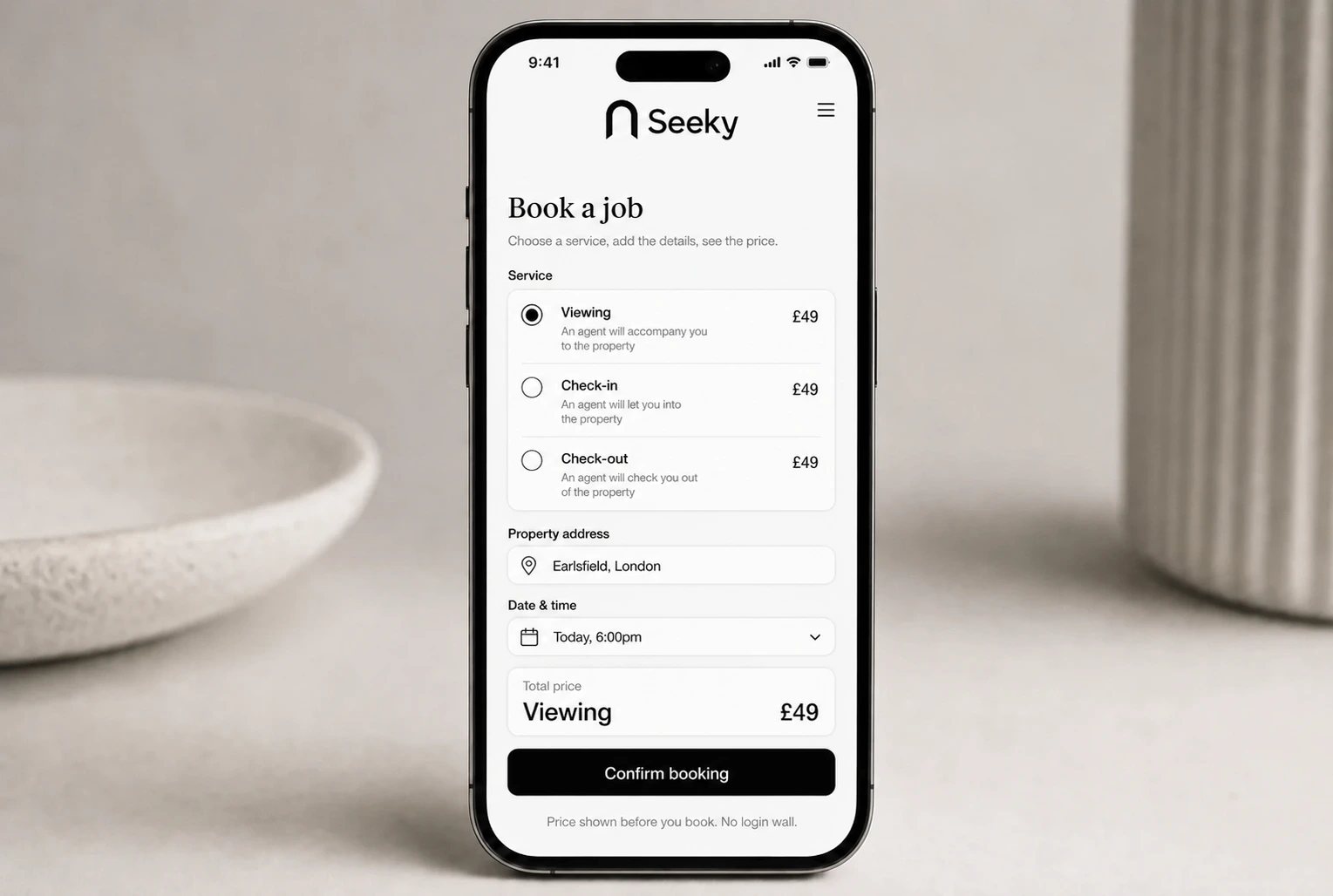
Ask people what frustrates them about property services and a familiar answer surfaces fast: not knowing what something costs until they're already committed. "Register to see prices." "Contact us for a quote." "Pricing available on request." Every one of those phrases asks the customer to spend effort and trust before they get a single number in return. The market is moving away from it, and for good reason.
Why hidden pricing took hold
Concealing prices isn't usually malice. It's a habit inherited from an era when quotes were genuinely bespoke and a phone call was the only way to qualify a lead. Hiding the number also let providers price by customer rather than by service, and kept competitors guessing. For a long time it worked, because everyone did it and customers had no alternative.
Those conditions have changed. People now expect to see a price the way they see it everywhere else they spend money. When one provider shows it and another doesn't, the gap is glaring - and it reads as something to hide.
What hidden pricing actually costs the provider
The irony is that opacity hurts the business using it. A price gate adds friction at the exact moment a customer is most interested, and friction leaks demand. It forces a sales conversation onto people who only wanted a number, burning staff time on tyre-kickers. And it plants a quiet doubt: if they won't tell me the price upfront, what else aren't they telling me?
Every "contact us for pricing" is a small tax on trust - paid by the customer, but ultimately charged back to the business in lost conversions.
What transparency changes
Showing the price upfront does three things at once. It removes friction, so an interested customer can act in the moment instead of waiting for a callback. It signals confidence - you're comfortable being compared, which itself reads as a mark of fair value. And it filters demand honestly: the people who proceed already accept the price, so conversations are warmer and shorter.
It also reframes the relationship. Instead of a negotiation where the customer suspects they're being sized up, it becomes a straightforward transaction between equals. That tone tends to carry through everything that follows.
Transparency is not the same as cheap
A common worry is that publishing prices forces a race to the bottom. It doesn't. Transparency is about clarity, not discounting. A premium service can show a premium price - what it can't do is hide it and hope the customer doesn't notice until they're committed. In fact, visible pricing often lets a quality provider justify a higher number, because the value is laid out plainly alongside it rather than buried in a quote that arrives after the customer has lost interest.
The standard property is moving towards
The services winning trust right now are the ones that treat pricing as information the customer is entitled to, not leverage to be withheld. You see the price, you decide, you proceed - no login wall, no quote chase, no surprise reveal. It's how the rest of modern commerce already works, and property is catching up.
This is the principle Seeky is built on. Every job shows its price before you book - by the viewing, by the inspection, by the visit - with no subscription and no hidden dashboard reveal. We think it's not just fairer, but a better business decision for everyone in the chain. See it for yourself on the pricing page.
See how Seeky covers your branch
Hand-picked Seekers handle the viewings, inspections and visits you can't staff - at a price you see before you book.
Seeky for agents